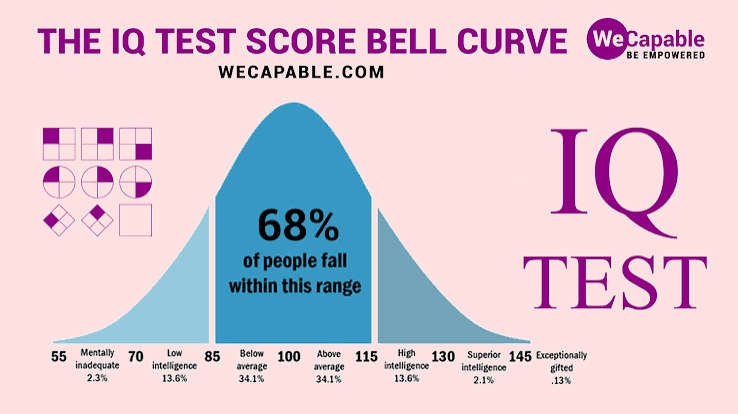

Understanding an iq score range can help explain where a person’s score falls compared with the population average. Intelligence quotient, commonly called IQ, is a standardized measure designed to assess certain cognitive abilities, such as reasoning, problem-solving, working memory, and verbal understanding.
Most modern IQ tests are designed around a population average of 100, with a standard deviation of 15. This means scores are interpreted relative to other people of the same age or relevant reference group rather than as a simple percentage or school grade.
However, an IQ score is only one measure of cognitive functioning. It does not capture every form of intelligence, creativity, practical ability, personality, motivation, or life experience. The American Psychological Association also notes that intelligence testing should be interpreted carefully and in context.
What Is the Typical IQ Score Range?
The commonly referenced iq score range for the general population centers around 100. Because most standardized IQ tests use a mean of 100 and a standard deviation of 15, a large proportion of people score relatively close to that average.
An IQ score around 85 to 115 is often considered within the broad average range. Approximately two-thirds of adults fall within this interval under a normal distribution model.
Scores above or below this area indicate that a person’s performance differed from the test’s reference population. Importantly, being outside the average range does not automatically mean someone is exceptionally gifted or has a cognitive disability.
For more background, readers can also explore our guide to intelligence testing.
IQ Score Range Chart Explained
A general interpretation of an iq score range can be described by looking at how far a score is from the population mean.
Scores around 90 to 109 are commonly described as falling within the average range. Scores from approximately 110 to 119 are often considered above average, while scores from about 120 to 129 are frequently described as superior.
An IQ of 130 or higher is sometimes associated with very high or gifted-level cognitive performance, although exact terminology and qualifying thresholds can vary depending on the test and organization.
At the lower end, scores around 80 to 89 may be described as below average, while scores around 70 to 79 are sometimes categorized as very low. These labels should not be treated as diagnoses because professional interpretation considers much more than the number itself.
READ MORE: Best Wireless Earbuds Under 200 Dollars 2024: Top Picks for Sound and Value
How Are IQ Scores Calculated?
Modern intelligence tests generally use standardized scoring rather than the original concept of dividing mental age by chronological age. Test developers compare performance with carefully selected norm groups and convert raw results into standardized scores.
The result is usually centered at 100. On many widely used assessments, a 15-point standard deviation is used, making the iq score range easier to interpret statistically.
For example, a score of 115 is one standard deviation above the mean. A score of 85 is one standard deviation below it. This does not mean that 115 represents a certain percentage of intelligence; it represents relative standing within the test’s normative population.
Does a High IQ Mean Someone Is More Intelligent?
A high score can indicate strong performance on the cognitive abilities measured by a particular assessment, but intelligence is broader than an IQ number.
IQ tests can measure areas such as verbal reasoning, visual-spatial reasoning, processing speed, and working memory. Different assessments emphasize these abilities in somewhat different ways.
The APA emphasizes that intelligence involves multiple abilities and that traditional intelligence tests do not necessarily measure every form of practical, creative, or social intelligence.
This is why an individual’s iq score range should be viewed as useful information rather than a complete description of their potential.
Can IQ Scores Change?
IQ scores are relatively stable compared with many other psychological measurements, but they are not perfectly fixed. Test performance can be affected by age, education, familiarity with testing, health, motivation, language, and other circumstances.
There is also a recognized phenomenon known as the Flynn effect, referring to historical changes in average performance on intelligence tests across generations. As a result, standardized tests are periodically renormed so scores remain meaningful relative to contemporary populations.
Measurement error also matters. A person’s observed score should not always be treated as an exact representation of their underlying cognitive ability. Professional assessment therefore considers confidence intervals and the overall pattern of test performance.
Why Context Matters When Interpreting IQ
An iq score range should never be interpreted without considering how the test was administered and who it was designed for.
Language, cultural background, educational opportunities, and familiarity with testing can influence performance. Research discussed by the APA highlights the importance of considering cultural and environmental factors when interpreting intelligence assessments.
For children or adults undergoing a formal psychological evaluation, a qualified professional can examine individual subtest scores, behavioral observations, background information, and adaptive functioning alongside the overall IQ score.
You can also read our related resource on how standardized tests work.
What Is the Best Way to Understand Your IQ?
If you want a meaningful interpretation of your score, the quality and type of assessment matter. Online quizzes may provide entertainment or a rough indication, but they should not automatically be treated as equivalent to a professionally administered intelligence test.
A comprehensive assessment can provide more useful information by showing strengths and weaknesses across different cognitive domains. It can also explain whether an overall score accurately represents the person’s abilities or whether individual subtest differences make the full-scale score less informative.
Ultimately, an IQ score is best understood as one piece of a much larger picture of human cognitive functioning.
Frequently Asked Questions About IQ Score Range
What is a normal IQ score?
A score around 100 represents the average on most modern standardized IQ tests. Approximately 85 to 115 covers a broad average range on tests using a mean of 100 and standard deviation of 15.
Is an IQ of 120 considered high?
An IQ of 120 is above the population average and is commonly described as superior or above average, depending on the specific test and its classification system.
What IQ score is considered gifted?
An IQ around 130 or higher is often used as a reference point for gifted-level cognitive ability, but gifted identification can involve additional criteria beyond a single score.
Can an IQ score change over time?
Yes. Scores can vary because of measurement error, development, education, testing conditions, and other factors. Intelligence-test norms can also change across generations.
Does IQ measure intelligence completely?
No. IQ tests measure important cognitive abilities, but they do not capture every aspect of intelligence, creativity, practical skills, emotional abilities, motivation, or life experience.
Conclusion
The iq score range provides a useful framework for understanding how an individual’s performance compares with a standardized population average. Most modern IQ tests use a mean of 100 and a standard deviation of 15, making scores such as 85, 100, 115, and 130 meaningful in terms of relative performance.
Still, an IQ score should not be viewed as a complete measurement of a person’s potential. Proper interpretation considers the specific test, testing conditions, cultural and educational context, measurement uncertainty, and the individual’s broader pattern of abilities.