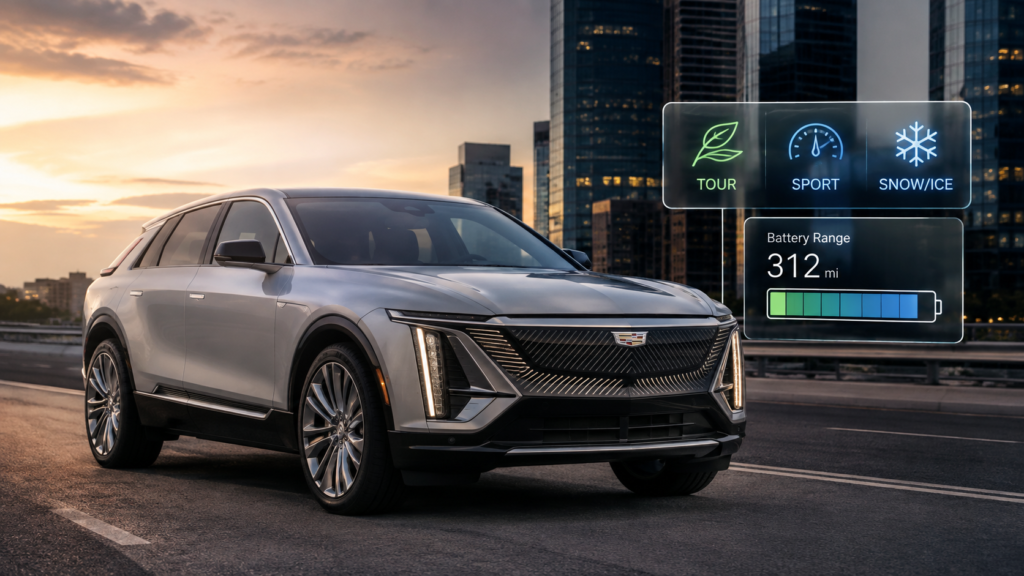

If you own or are considering a Cadillac LYRIQ, you may have wondered: do the driving modes in Cadillac LYRIQ offer different ranges or battery usages? The short answer is yes, but there is an important distinction. Changing the driving mode does not change the physical capacity of the LYRIQ’s battery. Instead, the selected mode changes how the vehicle responds to your inputs and how aggressively it uses available electrical energy.
Cadillac offers different drive settings to suit everyday driving, spirited performance, and slippery road conditions. Depending on the LYRIQ model and equipment, the available modes include Tour, Sport, Snow/Ice, and My Mode. Cadillac describes these modes as changes to the vehicle’s driving characteristics rather than separate battery or range settings.
That means you should not expect the dashboard to suddenly show a completely different official EPA range simply because you switch from Sport to Tour. However, your real-world range can change because acceleration, speed, traction, regenerative braking, and driving behaviour all influence how quickly the battery is consumed.
How Cadillac LYRIQ Driving Modes Actually Work
The LYRIQ’s driving modes are essentially software-based adjustments to the way the vehicle behaves. The electric motors, accelerator response, steering, suspension where equipped, and traction systems can be calibrated differently depending on the selected mode. Cadillac says Tour is designed for smooth everyday driving, while Sport provides a more immediate and performance-focused response.
This is important because an EV does not use electricity at exactly the same rate under every driving situation. A gentle accelerator response can make it easier to accelerate smoothly, while a sharper response can encourage stronger bursts of power. The battery itself has not changed, but the way energy leaves the battery can be very different.
The same principle applies to Snow/Ice mode. It is designed around traction rather than maximum efficiency or performance. Cadillac explains that this mode adjusts pedal tuning to optimise traction on slippery surfaces and can modify electric all-wheel-drive and steering behaviour on equipped vehicles.
Does Tour Mode Give the LYRIQ Better Range?
For everyday driving, Tour is generally the most sensible choice if efficiency is your priority. Cadillac describes Tour as the predominant everyday mode, with tuning intended to provide a smooth ride. A smoother driving response can make it easier for the driver to avoid unnecessary bursts of acceleration, which can help reduce energy consumption.
However, it would be inaccurate to say that Tour mode automatically guarantees a specific number of additional miles. Your actual range depends on far more than the mode selector. Cadillac specifically identifies driving technique, speed, terrain, climate settings, outside temperature, and weather as factors that can affect energy use and electric range.
In other words, a LYRIQ driven aggressively in Tour mode could still use more energy than a LYRIQ driven gently in Sport mode. The driver’s behaviour matters enormously. If you want to maximise range, concentrate on smooth acceleration, sensible highway speeds, appropriate climate settings, and predictable driving rather than simply selecting one mode and expecting a fixed range increase.
Does Sport Mode Use More Battery?
Sport mode can lead to higher energy consumption because it is designed to make the LYRIQ feel more responsive. Cadillac says Sport mode provides a more controlled response and improves handling and acceleration on dry pavement. It also changes pedal tuning and other vehicle characteristics.
The important point is that Sport mode does not appear to reduce the battery’s usable capacity. Instead, it can encourage a driving style that demands more power from the electric motors. Rapid acceleration requires substantial electrical energy, and repeated hard acceleration can therefore reduce the distance you can travel before needing to recharge.
This does not mean Sport mode should be avoided. If you enjoy the LYRIQ’s performance, Sport is there for precisely that reason. The trade-off is simply that performance-focused driving can consume energy faster. Cadillac’s own range guidance warns that rapid acceleration and higher speeds use more energy and can significantly reduce range.
What About Snow/Ice Mode and Battery Consumption?
Snow/Ice mode is a slightly different case because its primary goal is traction. Cadillac designed the mode to help prevent wheel spin and improve vehicle behaviour on slippery roads. It changes accelerator pedal tuning so that power delivery is better suited to conditions such as snow and ice.
When traction is poor, the vehicle may need to manage the electric motors differently from normal dry-road driving. On equipped LYRIQ models, Snow/Ice mode can also modify the electric all-wheel-drive system and steering. That means energy consumption can vary depending on the road surface, temperature, tyres, and amount of traction required.
Cold weather itself can be a much bigger range factor than the name of the selected drive mode. Cadillac notes that outside temperature can affect range, while heating or cooling the cabin and propulsion battery can also increase energy demand. So if you see lower efficiency in winter, it would be misleading to blame Snow/Ice mode alone.
Does My Mode Let You Control Battery Usage?
My Mode gives LYRIQ drivers more control over the driving experience by allowing certain characteristics to be personalised. Depending on vehicle equipment, Cadillac allows settings such as acceleration feel, brake feel, steering, suspension, and motor sound to be adjusted.
This makes My Mode particularly interesting for drivers who want a compromise between comfort and responsiveness. You could choose a relaxed acceleration feel while keeping other preferences more responsive. The exact available settings depend on the vehicle’s equipment and configuration, so not every LYRIQ will offer identical customisation.
My Mode does not create a larger battery or unlock a hidden range reserve. Instead, it lets you influence how the vehicle behaves. If your settings encourage smoother acceleration and calmer driving, you may see better real-world efficiency. If you configure the car for sharper responses and then use those responses frequently, consumption can naturally rise.
Regenerative Braking Also Matters
Driving mode is only one part of the LYRIQ’s energy-management story. Regenerative braking is another important factor because the vehicle can recover some energy during deceleration instead of wasting all of that kinetic energy as heat through conventional friction braking. Cadillac lists regenerative braking as a technology intended to conserve and capture braking energy for added range.
That does not mean every braking event puts all the energy back into the battery. Regeneration has limits, and energy is inevitably lost during conversion. Battery temperature and state of charge can also affect regenerative and one-pedal-driving functionality. Cadillac notes that these features can be limited when the battery is extremely cold or hot or when it is near full charge.
For everyday efficiency, smooth anticipation is therefore more useful than simply switching modes. If you can gradually slow down, avoid unnecessary acceleration, and use the vehicle’s regenerative capabilities appropriately, you can generally make better use of the energy already stored in the battery.
What Has the Biggest Effect on LYRIQ Range?
It is easy to focus on the drive-mode selector because it is something you can change instantly. In practice, several other factors can have a larger effect on range. Speed is particularly important. Driving at higher speeds increases aerodynamic resistance, requiring more energy to maintain motion. Cadillac specifically warns that higher speeds can significantly reduce electric range.
Temperature is another major consideration. Extreme heat and cold can affect battery performance, while climate control adds another electrical load. Heating a cabin in cold weather can therefore reduce the energy available for propulsion, while heavy air-conditioning use in hot weather can also affect efficiency.
Terrain and weather matter too. Hills, strong wind, rain, snow, and additional vehicle load can all change energy consumption. This explains why two LYRIQ drivers using exactly the same driving mode can report noticeably different ranges. The official range figure is a useful benchmark, but it is not a promise of identical real-world results.
Should You Leave the LYRIQ in Tour Mode?
For most daily driving, Tour is the easiest mode to recommend. It is designed around comfort and balanced everyday performance, making it a natural default for commuting, city driving, and normal highway trips.
If you are planning a long journey and want to make the most of your available charge, Tour combined with smooth driving is a sensible approach. Keep acceleration gradual, avoid unnecessarily high speeds, and use climate controls thoughtfully. Those habits can be more important than obsessing over the difference between driving modes.
At the same time, there is no reason to avoid Sport mode simply because you are concerned about battery consumption. If you want sharper acceleration and a more engaging driving experience, use it when appropriate. Just understand that frequent hard acceleration can consume energy faster than relaxed driving.
The Bottom Line on LYRIQ Driving Modes and Range
So, do the driving modes in Cadillac LYRIQ offer different ranges or battery usages? Yes, they can influence real-world battery usage and therefore the distance you achieve from a charge, but they do not change the physical size or basic capacity of the battery. The effect comes from changes in power delivery, accelerator response, traction behaviour, and the way you drive.
Tour is the best all-around choice when efficiency and comfort are your priorities. Sport is designed for stronger responsiveness and can result in higher energy consumption when you take advantage of its performance characteristics. Snow/Ice prioritises traction, while My Mode lets you customise selected driving characteristics.
Ultimately, the biggest lesson is that driving mode is only one piece of the range puzzle. Speed, acceleration, temperature, terrain, weather, climate control, battery conditions, and driving habits can all have a substantial impact. The LYRIQ’s battery does not magically become smaller in Sport or larger in Tour; instead, the car changes how it delivers and manages the energy you already have.
For drivers who want maximum practical range, the winning formula is simple: use Tour for normal journeys, drive smoothly, keep speeds reasonable, plan around weather and terrain, and make sensible use of regenerative braking. That approach will generally do far more for efficiency than switching between modes alone.
You May Also Read: publixa