
Introduction
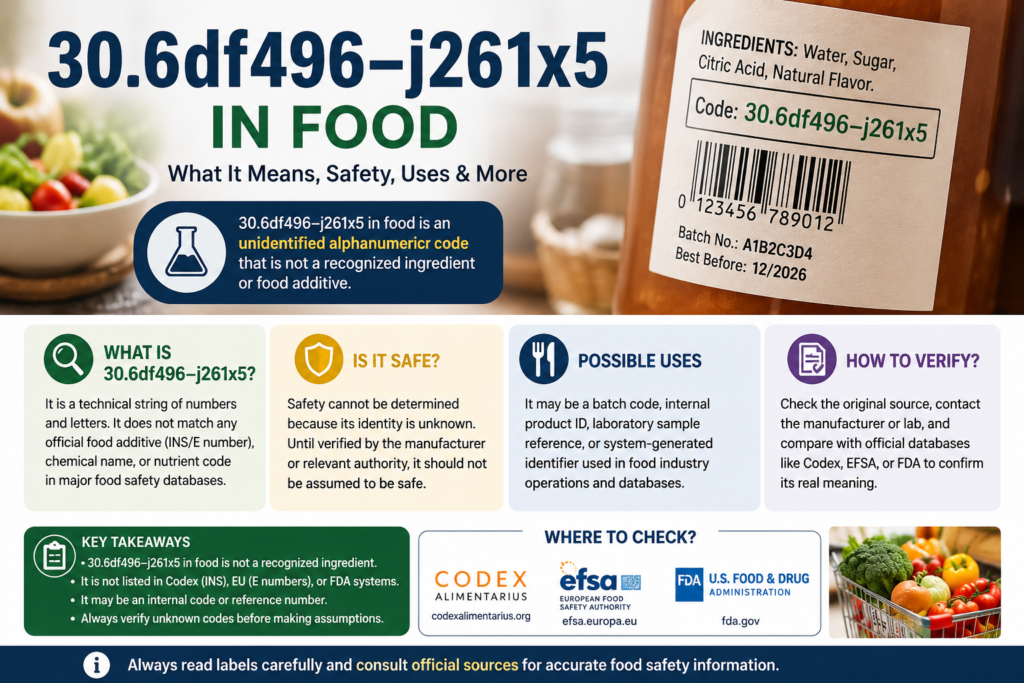
30.6df496–j261x5 in food is an unusual alphanumeric phrase that does not correspond to a recognized food ingredient, food additive, nutrient, or standard culinary term in the authoritative food-regulatory references reviewed for this article. Its combination of numbers, letters, a decimal point, and a dash makes it look technical, but appearance alone cannot establish what a code represents.
This distinction matters because food terminology is highly structured. Legitimate additives and food substances are normally identified by recognized names, regulatory classifications, chemical identities, or established numbering systems. The Codex Alimentarius, for example, uses the International Numbering System (INS) to identify food additives, while the European Union uses E numbers for authorized additives.
Quick Answer: What Is 30.6df496–j261x5 in Food?
30.6df496–j261x5 in food is not currently identifiable as a recognized food ingredient or approved food-additive designation. It is more appropriately treated as an unidentified technical string unless the original source provides additional context.
That does not prove that the string is dangerous. It means there is insufficient authoritative evidence to assign it a chemical, nutritional, culinary, or food-safety function. If you encounter the term on a label, recipe, database, laboratory document, or website, the surrounding information is essential.
What Does 30.6df496–j261x5 in Food Actually Mean?
There is no verified standard definition for 30.6df496–j261x5 in food. Unlike familiar food identifiers, the string does not immediately communicate a substance’s identity, function, or permitted level of use.
For comparison, Codex maintains a searchable database of food additives that can be queried by additive name, synonym, or INS number. Its food-additive system includes recognizable substances and functional classifications such as antioxidants, acidity regulators, anticaking agents, and antifoaming agents.
The unusual format of 30.6df496–j261x5 therefore should not be interpreted as evidence that it is a new chemical or secret food ingredient. A technical-looking string can have many possible origins, including an internal reference, database identifier, software-generated value, laboratory sample code, or formatting error. Without documentation from the original source, however, these possibilities remain possibilities rather than established facts.
Is 30.6df496–j261x5 a Food Additive?
No authoritative evidence reviewed identifies 30.6df496–j261x5 as a recognized food additive.
Food additives are substances intentionally added to food for technological purposes, such as maintaining freshness, changing texture, controlling acidity, or improving appearance. The European Food Safety Authority explains that food additives are evaluated before they are permitted for use in food within the European Union, and authorized additives receive E-number designations.
Codex uses the International Numbering System for Food Additives, commonly called INS. Its database provides identifiers and information concerning additive functions and permitted uses.
The string 30.6df496–j261x5 does not follow that recognizable format. It should therefore not be presented as an INS number, E number, preservative code, color additive, flavoring identifier, or other established food-additive designation without evidence from an authoritative source.
Why Does 30.6df496–j261x5 Look Like a Food Code?
The structure of 30.6df496–j261x5 in food can easily create confusion. Numbers and letters are frequently used throughout the modern food industry, so consumers may reasonably assume that any unusual combination is a regulated food identifier.
However, not every code associated with food is an ingredient code.
Food manufacturers, laboratories, warehouses, retailers, and software systems can use internal identifiers to organize products, samples, batches, inventory records, recipes, or manufacturing information. Such identifiers may be meaningful inside a particular organization while being meaningless outside that system.
This is why the source of the string matters more than its appearance.
If 30.6df496–j261x5 appears next to an ingredient list, it should not automatically be treated as an ingredient. If it appears beside a product number or laboratory sample reference, its purpose may be completely different.
How Food Additive Identification Normally Works
Understanding legitimate food identifiers makes it easier to recognize why 30.6df496–j261x5 in food is unusual.
E Numbers in the European Union
The European Union uses E numbers for authorized food additives. EFSA notes that food additives are assigned E numbers and that their safety is evaluated before permission for use. Examples include vitamin C as E300 and pectin as E440.
An E number is therefore part of a defined regulatory framework rather than an arbitrary combination of characters.
INS Numbers
Codex uses the International Numbering System to provide standardized numerical identifiers for food additives. Its database allows users to search for additives using an INS number, name, synonym, functional class, or food category.
This system provides a useful comparison: recognized additive identifiers are connected to specific substances and documented technological purposes.
FDA Food-Ingredient Inventories
In the United States, the Food and Drug Administration maintains searchable inventories concerning substances added to food. The FDA’s Substances Added to Food inventory includes food additives, color additives, certain GRAS substances, prior-sanctioned substances, and other regulatory categories.
The FDA also provides food-ingredient and packaging inventories designed to help users determine the regulatory status of substances associated with food.
Could 30.6df496–j261x5 Be a Chemical?
There is not enough verified information to say that 30.6df496–j261x5 in food represents a chemical compound.
A chemical identity normally requires more than a string that looks technical. Depending on the context, useful identifying information might include a chemical name, molecular formula, CAS Registry Number, molecular structure, manufacturer specification, or regulatory identifier.
Without such information, assigning a chemical identity to the code would be speculation.
This is particularly important when discussing substances that might come into contact with food. A strange code should never be converted into a supposed ingredient or chemical simply because its format resembles a scientific identifier.
Is 30.6df496–j261x5 Safe to Eat?
The safety of 30.6df496–j261x5 cannot be determined from the code alone.
At the same time, the lack of an established identity is a reason not to consume an unidentified substance merely because someone associates the code with food online.
If the term appears on actual food packaging, the safest approach is to identify the product, manufacturer, complete ingredient declaration, lot or batch information, and any relevant regulatory markings. The manufacturer or appropriate food-safety authority can then clarify what the unfamiliar code means.
A web page claiming that a mysterious code is edible is not sufficient evidence of food safety.
What Should You Do If You Find the Code on Food Packaging?
Start by checking exactly where the string appears. Ingredient lists, lot numbers, manufacturing codes, barcodes, product identifiers, and laboratory references serve different purposes.
Look at the characters carefully as well. A misplaced dash, altered letter, missing character, or OCR error can change an identifier completely.
Next, compare the surrounding information with the manufacturer’s official product documentation. If the code appears in a laboratory report, contact the laboratory or organization that issued the report rather than attempting to interpret it independently.
For regulatory questions, official databases are preferable to social-media posts or unsourced articles. The FDA provides searchable food-ingredient resources, while Codex provides its own searchable food-additive database.
30.6df496–j261x5 in Food vs. Recognized Food Codes
| Identifier or term | What it normally represents | Recognized system? |
|---|---|---|
| 30.6df496–j261x5 | Unidentified string based on available evidence | No verified standard meaning |
| E300 | Vitamin C/ascorbic acid when used as an additive | Yes |
| INS number | International food-additive identification | Yes |
| CAS Registry Number | Chemical substance identification | Yes |
| Batch or lot code | Product or production traceability | Manufacturer-specific |
The comparison shows why context is essential. A recognized identifier connects to a documented system and a defined meaning. 30.6df496–j261x5 in food currently lacks that verified connection.
Common Mistakes When Researching 30.6df496–j261x5 in Food
One common mistake is assuming that every number associated with food represents an additive. Food packaging contains many types of information, and only some of it describes ingredients.
Another mistake is treating repetition online as proof. If multiple websites repeat the same explanation, that does not necessarily establish its accuracy. Several pages may simply be repeating the same unsupported claim.
A third mistake is inventing a chemical explanation from the appearance of a code. Scientific nomenclature has conventions, and an unfamiliar alphanumeric sequence should not automatically be interpreted as a molecular formula or additive designation.
The better approach is to trace the term back to its original source and verify it against authoritative documentation.
Best Practices for Verifying an Unknown Food Term
When researching 30.6df496–j261x5 in food, prioritize the original source. A manufacturer’s specification, government database, laboratory document, or official regulatory publication carries considerably more evidentiary value than an anonymous blog post.
Then determine what type of information you are looking at. Ask whether it is an ingredient name, additive identifier, batch number, product code, laboratory reference, or software-generated value.
Finally, avoid making safety claims until the identity is established. Food safety depends on the actual substance, concentration, exposure, intended use, and applicable regulations—not on how a code looks.
Key Takeaways
30.6df496–j261x5 is not currently recognized as a standard food ingredient or food-additive identifier.
Its unusual format does not establish that it is a chemical, preservative, flavoring, or processing aid.
Recognized food-additive systems such as Codex INS numbers and EU E numbers have defined structures and documented meanings.
The FDA maintains searchable information on substances added to food and related regulatory categories.
If you encounter the code on packaging or in a food document, verify it with the original source rather than assuming what it means.
FAQs About 30.6df496–j261x5 in Food
What is 30.6df496–j261x5 in food?
It is an unexplained alphanumeric string that does not have a verified standard definition as a food ingredient, additive, nutrient, or recognized food code in the authoritative references reviewed.
Is 30.6df496–j261x5 a food additive?
There is no authoritative evidence reviewed identifying it as a recognized food additive. It should not be described as an additive without documentation establishing its identity and regulatory status.
Is 30.6df496–j261x5 safe to consume?
Its safety cannot be assessed because its identity and intended use have not been established. An unidentified substance should not be consumed simply because it appears in food-related content.
Does the code represent an E number?
No. E numbers are part of the European Union’s established food-additive identification system. The format of 30.6df496–j261x5 does not correspond to an E-number designation.
Is it an INS number?
It does not match the normal numerical format used by Codex’s International Numbering System for food additives. Codex provides a searchable database for INS-numbered additives.
Could it be a batch or product code?
That is possible, but it cannot be confirmed without the original source. Manufacturers and other organizations can create internal identifiers for products, samples, or production records.
Why are people searching for 30.6df496–j261x5 in food?
The term may have appeared in food-related online content, prompting readers to search for an explanation. Search interest itself does not establish that the term represents a real ingredient or regulated substance.
Where can I verify an unfamiliar food ingredient?
Start with the product manufacturer and relevant regulatory databases. In the United States, FDA food-ingredient inventories are useful starting points, while Codex provides an international food-additive database.
Conclusion
30.6df496–j261x5 in food should currently be treated as an unidentified technical string rather than a confirmed ingredient, additive, nutrient, or culinary substance. The available authoritative food-regulatory systems use documented names and structured identifiers, and this particular sequence does not have a verified place within those systems.
The most responsible way to investigate the term is to return to its original context. Check the packaging, manufacturer, laboratory document, database, or webpage where it appeared, and compare the information with recognized food-safety resources. Until its identity is established, claims about its uses, benefits, chemical properties, or safety should not be presented as fact.